Enlarged prostate (BPH): Causes, symptoms, and current treatments
Author

William Devan, MD

Benign prostatic hyperplasia (BPH), or an enlarged prostate is one of the most common health issues men face as they age. It often causes frustrating urinary symptoms that can disrupt daily life.
What causes an enlarged prostate/BPH?
BPH is a non-cancerous growth of the prostate gland that happens with aging. It depends on male hormones, mainly testosterone and its more active form, dihydrotestosterone (DHT). Why some men's prostates grow more than others is not fully understood.
BPH is uncommon before age 40. About 50% of men in their 50s and up to 90% of men in their 80s have BPH. Not every man with an enlarged prostate has symptoms.
Are there risk factors that make BPH more likely?
The two main risk factors are ones you cannot change -- age and genetics.
BPH runs in families. Studies of twins suggest that roughly 40% to 70% of BPH risk is inherited. No single "BPH gene" has been found. Instead, many genes each add a small amount of risk. Having a father or brother with BPH, especially one who needed treatment at a younger age, raises your risk.
Some health and lifestyle factors are also linked to BPH. Men with obesity (especially extra weight around the waist), type 2 diabetes, and men who are not physically active, are more likely to have a larger prostate and more bothersome urinary symptoms.
These studies show a link, but they do not prove that these conditions cause the prostate to grow. Diabetes, heart and blood vessel disease, and excess weight can also affect the bladder and the amount of urine the body makes, so they can make urinary symptoms worse whether or not the prostate is enlarged.
There is no proven way to prevent BPH. Staying physically active and keeping a healthy weight are good for overall health and may reduce urinary symptoms.
What are the symptoms of an enlarged prostate/BPH?
As the prostate grows, it can squeeze the urethra (the tube that carries urine out of the body) and make the bladder work harder. Symptoms can include:
- A weak or slow urine stream
- Trouble starting urination, or needing to strain
- A stream that stops and starts
- Dribbling at the end of urination
- Feeling that the bladder does not empty completely
- A frequent or urgent need to urinate
- Waking at night to urinate (nocturia)
Complications that can develop from BPH include:
- Urinary tract infections
- Being unable to pass urine (urinary retention)
- Blood in the urine (hematuria)
- Bladder stones
- Kidney damage
Pain or burning with urination is not a typical BPH symptom. It can be a sign of infection or another condition and should be evaluated.
Many other conditions can cause the same urinary symptoms, so it is important to speak with your healthcare provider to find the cause and the treatment options that are right for you.
Seek medical care right away if you:
- Cannot pass urine at all
- Have blood or blood clots in your urine
- Have pain in your lower abdomen along with trouble urinating
- Have painful, frequent urination with a fever and chills
How is BPH diagnosed?
Your provider will ask about your symptoms, health history, medications and family history. You may be asked to fill out a short symptom questionnaire. The exam may also include:
- Urinalysis: a urine test to check for infection, blood or other problems
- Post-void residual: a quick, painless office ultrasound of the bladder after you urinate, to see how well it empties
- Digital rectal exam: a brief exam to feel the size and shape of the prostate
- Voiding tests: (Uroflow, UroCuff or Urodynamics) to determine how well you urinate.
- Imaging: pictures to measure the size and shape of the prostate, such as an ultrasound (done over the lower abdomen or through the rectum), a CT scan or an MRI
- Office cystoscopy: a thin, flexible camera passed through the urethra to look at the urethra, prostate and bladder
Most men do not need every test. Imaging, cystoscopy and urodynamics are usually done if a procedure is being considered or the cause of symptoms is unclear.
Your provider may also talk with you about a prostate-specific antigen (PSA) blood test. PSA is used mainly to screen for prostate cancer, and the decision to test is one you and your provider make together.
Does having BPH increase the risk for prostate cancer?
No. BPH is a benign (non-cancerous) enlargement of the prostate. It does not turn into or cause prostate cancer. However, a man can have both conditions at the same time, as both become more common with age.
Both BPH and prostate cancer can raise the PSA level in the blood. A high PSA does not mean you have cancer, but it may need a closer look. This can include a repeat PSA test, a physical exam, an MRI or a prostate biopsy.
What are the treatments for an enlarged prostate/BPH?
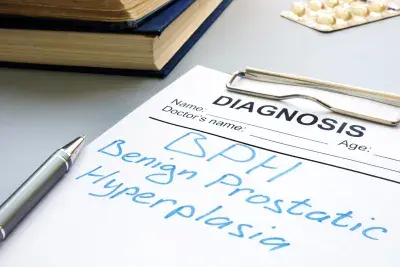
Treatments for BPH include watchful waiting, lifestyle changes, medications, minimally invasive procedures and surgery.
Watchful waiting – for men with mild symptoms that do not disrupt daily life, regular check-ins with your provider may be all that is needed.
Lifestyle changes – can reduce symptoms and are recommended before, or along with medication:
- Drinking fewer liquids before bed or before going out
- Limiting alcohol and caffeine
- Being physically active and keeping a healthy weight
- Preventing and treating constipation, since a full bowel can press on the bladder and make urinary symptoms worse
- Urinating on a regular schedule (for example, every 2 hours) rather than holding urine for long periods
- Taking your time to empty your bladder completely, while relaxing and not straining or pushing to do so. Waiting a moment and trying a second time ("double voiding") can help.
- Reviewing your medications with your provider. Some can worsen urinary symptoms, including over-the-counter cold and allergy medicines (decongestants and antihistamines), opioid pain medicines, diuretics ("water pills") and some antidepressants. Do not stop a prescription medicine without talking to the provider who prescribed it.
Medications – several types of medicine treat BPH symptoms:
- Alpha-blockers relax the muscle in the prostate and bladder neck, making it easier to urinate. They work within days.
- 5-alpha reductase inhibitors block the hormone (DHT) that drives prostate growth and shrink the prostate over time. They work best in men with larger prostates and can take 6 to 12 months for full effect. They also lower the PSA level, so tell any provider checking your PSA that you take one.
- Tadalafil, taken daily, can improve urinary symptoms and may be a good choice for men who also have erectile dysfunction.
- Bladder-relaxing medicines may be added for men whose main symptoms are urgency and frequency.
- Combination therapy uses two medicines together, most often an alpha-blocker and a 5-alpha reductase inhibitor.
Minimally invasive procedures – often done as outpatient procedures, minimally invasive options have a quicker recovery and fewer sexual side effects than surgery. These procedures are less effective than surgery in improving urine flow, and some men need another treatment later.
- Prostatic urethral lift (Urolift) uses tiny implants to hold the prostate tissue away from the urethra so urine flows more freely.
- Water vapor therapy (Rezum) uses small amounts of steam to destroy excess prostate tissue, which the body then absorbs over several weeks.
- Prostate artery embolization (PAE) is done by an interventional radiologist. Tiny beads are placed in the blood vessels that feed the prostate, reducing its blood supply so it shrinks over time.
Surgery – removes the inner part of the prostate that is blocking urine flow. It does not remove the whole gland. Surgery gives the greatest improvement in urine flow. Options include:
- Transurethral resection of the prostate (TURP), in which tissue is removed through the urethra
- Laser surgery (HoLEP or ThuLEP), which removes or vaporizes tissue with a laser. Laser enucleation can be used for prostates of any size.
- Waterjet therapy (Aquablation therapy), which uses a robot-guided, heat-free waterjet to remove excess prostate tissue. Aquablation is performed in an operating room under anesthesia. South Shore Health is the first in the region to offer this treatment for enlarged prostate.
- Robotic simple prostatectomy, which removes the inner part of a very large prostate through small incisions.
How do I know which BPH treatment is right for me?
The right treatment depends on how much your symptoms bother you, the size and shape of your prostate, your other health conditions and what matters most to you, including recovery time and sexual side effects.
Treating BPH should begin with a conversation with your health care provider, who will work with you to evaluate your symptoms and goals before recommending a personalized treatment plan.
William J Devan, MD is an urologist at South Shore Urology in Weymouth. Learn more about urologic care at South Shore Health.
Author
William Devan, MD