Aquablation Therapy for Enlarged Prostate (BPH)

A middle-aged Black man looks happy as he jogs along an asphalt path in a hilly/mountain looking setting

Contact South Shore Urology

To learn more about Aquablation therapy, please schedule an appointment with South Shore Urology.

Aquablation therapy is a minimally invasive surgical treatment for BPH (benign prostatic hyperplasia), more commonly known as enlarged prostate.

This advanced method uses a robotic-assisted, heat-free waterjet to target prostate tissue causing enlarged prostate symptoms.

Aquablation therapy can be a good option for patients who want to stop taking daily BPH pills or those looking for an alternative to more traditional BPH treatments, like TURP (transurethral resection of the prostate).

Providing Aquablation Therapy on the South Shore

We’re proud to bring this cutting-edge treatment to our community by being the first to offer Aquablation therapy on the South Shore.

Experts from South Shore Urology, part of South Shore Health, have extensive training and experience in Aquablation therapy.

Our team will determine if this treatment is right for you and create a personalized care plan to meet your needs.

To schedule an appointment at South Shore Urology, please call 781-331-4600 or speak to your primary care provider about a referral.
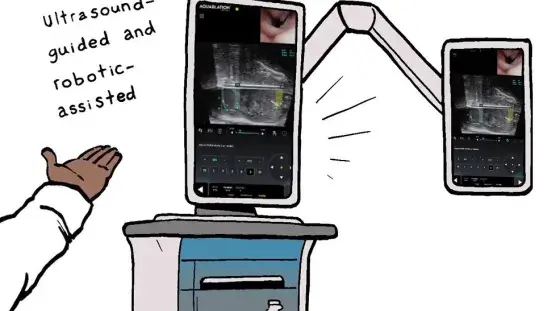
Virtual drawing showing a Procept Biorobotics Hydros system with text reading "ultrasound-guided and robotic-assisted"

How Does Aquablation Therapy Work?

Aquablation therapy uses an ultrasound-guided, robotic-assisted, heat-free waterjet to precisely target prostate tissue causing BPH symptoms.

Click below for a video explanation of how the procedure works.

Still image of Howard, a Florida resident, from a video testimonial about his experience with Aquablation therapy

Howard's Aquablation Therapy Story

After living with BPH for years and seeing little improvement while on medication, Howard was looking for a different solution.

He found that solution in Aquablation therapy, which provided him with improved bladder control, stronger urinary flow, and no sexual side effects.

Aquablation Therapy Providers at South Shore Health

Frequently Asked Questions About Aquablation Therapy

Curious about how Aquablation therapy works? Click to expand each section below and find answers to frequently asked questions on the procedure, recovery time, and more.

Aquablation therapy uses a combination of advanced ultrasound imaging and a robotic-assisted, heat-free waterjet to remove the prostate tissue causing symptoms.

Because every prostate is a unique size and shape, your surgeon will customize your Aquablation therapy experience to your specific situation.

Your surgeon will use ultrasound imaging to create a surgical map that outlines the critical anatomy of your prostate and identifies the prostate tissue that can be safely removed.

With that surgical map in place, your surgeon will use a heat-free waterjet guided by the HYDROS™ Robotic System to remove the excess tissue with extreme precision.

Yes—your surgeon will access your prostate through your urethra, with no abdominal incisions required.

This minimally invasive approach means you will have no visible scarring and a faster recovery time when compared to more invasive laparoscopic procedures.

At South Shore Health, our surgeons perform Aquablation therapy procedures in the operating rooms at South Shore Hospital.

Our team will put you under general anesthesia for the entire procedure, which normally takes an hour.

Some patients will return home the day of their procedure, while others will spend a night in the hospital to recover.

When it comes to surgical treatment for BPH, many patients are concerned about permanent incontinence or impacts to sexual function.

Clinical studies found that Aquablation therapy patients had very low rates of irreversible complications like incontinence, ejaculatory dysfunction, and erectile dysfunction.

In addition, clinical studies show that when compared to TURP, Aquablation therapy showed similar symptom relief with a lower complication rate and fewer retreatments.

On average, Aquablation therapy patients in clinical studies experienced improvement in urinary flow rate and a 16-point improvement in their International Prostate Symptom Score.
 

Clinical study references: Gilling PJ, et al. Can J Urol. 2022; Bhojani N, et al. J Urol. 2023; Elterman D, et al. BMJ Surg Interv Health Technol. 2021; Data on file, PROCEPT BioRobotics; and Oumedjbeur K, et al. Can J Urol. 2023.

After the procedure, patients will wake up with a catheter in place. The catheter allows urine to continue to flow from your body while also giving your urethra time to heal.

Common side effects after Aquablation therapy include a burning sensation when urinating, blood or tissue debris in urine, urinary symptoms (force of stream, hesitancy, and intermittency), and increased urinary frequency, urgency, and nighttime urinating.

These side effects typically resolve within two to four weeks after your procedure, though some may take several months to resolve fully.

Most patients can manage any post-procedure discomfort with mild pain medication.

Like most procedures, Aquablation therapy may not be the right fit for everyone.

Our providers at South Shore Urology will work with you to evaluate your BPH symptoms and discuss your goals before recommending the right course of treatment.